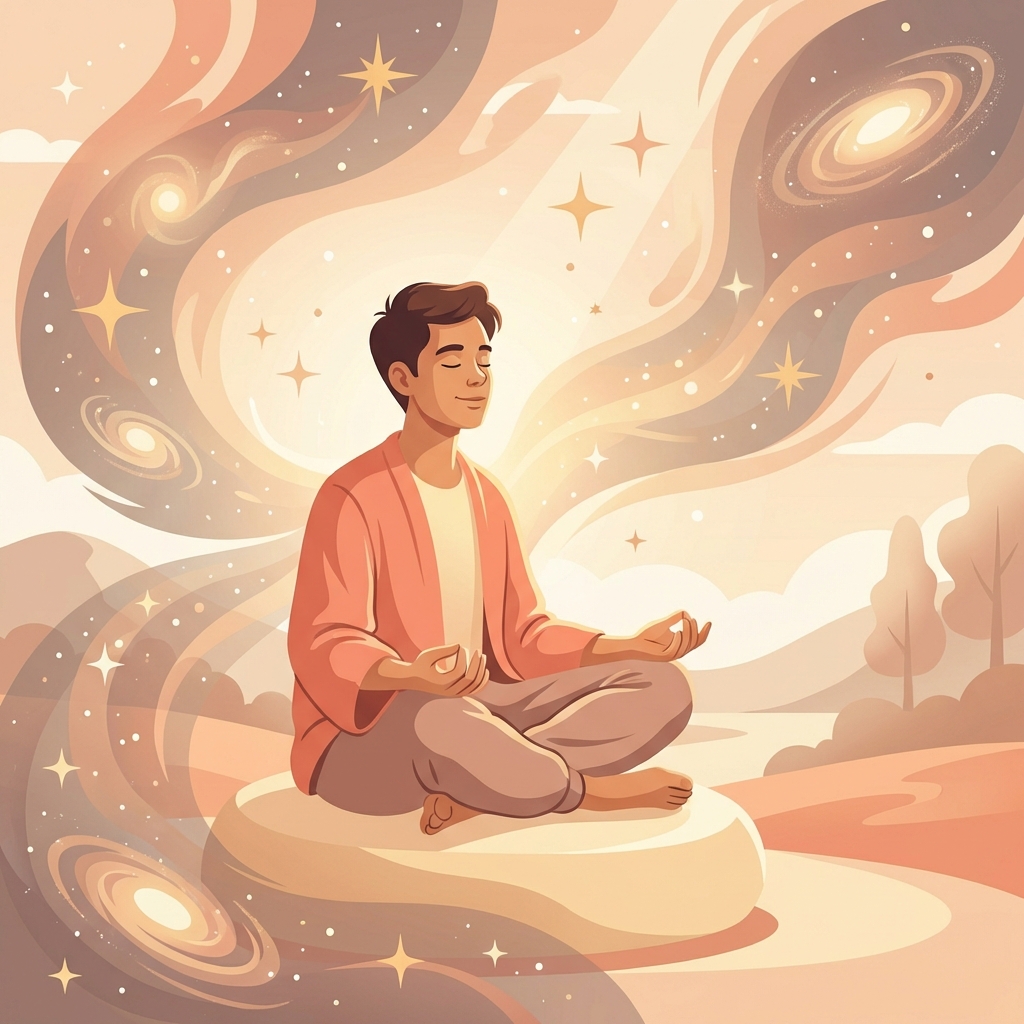
From quantum physics to ancient sages—what science, mathematics, philosophy, and the great masters agree on about how to live a truly fulfilling life.
What if everything you've been told about how to live is wrong?
The Questions That Will Change Everything
What if I told you that quantum physics and ancient sages agree on the same thing? That mathematicians and mystics discovered identical truths 3,000 years apart?
What if the secret to happiness has nothing to do with getting what you want?
What if you're already free—but you've been looking for freedom in all the wrong places?
In the next 22 minutes, I'm going to show you something extraordinary: a map of human wisdom that spans quantum mechanics to the Ashtavakra Gita, from neuroscience to Osho, from Stoic philosophy to the Tao Te Ching.
And here's the thing that surprised me most: they all say the same thing.
Beneath the surface differences—different cultures, different centuries, different languages—there are patterns. Universal principles that keep appearing whether you're reading Einstein or Buddha, whether you're studying neuroscience or Krishnamurti.
By the end of this article, you'll know:
- Why 99% of your suffering is completely optional
- The one thing every wisdom tradition agrees on (and why we keep ignoring it)
- What science has proven about happiness that contradicts everything society teaches
- Why the "self" you're trying to improve doesn't exist—and why that's the best news ever
- The 6 universal principles for living fully that appear in every tradition
This isn't philosophy for philosophers. This is a practical guide to being alive.
Ready? Let's go.
Part 1: What Science Reveals
The Physics Perspective
Let's start with the hardest science: physics.
At the quantum level, reality is not what we think it is. Particles exist as probability waves until observed. The observer affects the observed. Solid matter is 99.99% empty space. Time is relative. Space curves.
What does this mean for living?
- Reality is participatory. You're not a passive observer of a fixed universe—you're an active participant in creating what you experience.
- Certainty is an illusion. At the deepest level, everything is probability, not fixed destiny. This means genuine freedom exists.
- Connection is fundamental. Quantum entanglement shows that separated particles remain connected instantaneously. Separation is a surface appearance.
The physicist David Bohm called it the "implicate order"—a deeper level where everything is interconnected, enfolded into everything else.
"The universe is not a collection of objects, but a communion of subjects."
— Thomas Berry
The Biology Perspective
Biology reveals something equally profound: life is not about survival—it's about flourishing.
Yes, organisms survive. But look closer:
- Trees grow taller than they need to for mere survival
- Birds sing more beautifully than necessary for mating
- Flowers bloom in colors that serve no survival purpose
Life has an inherent drive toward more—more complexity, more beauty, more expression. This is not struggle; this is celebration.
Neurobiologically, humans have evolved for:
- Connection — We're wired for empathy, mirror neurons, and social bonding
- Creativity — Our brains are pattern-making, imagination machines
- Meaning — We suffer without purpose, regardless of material comfort
- Growth — Neuroplasticity means we can change at any age
The biological message? You are built to grow, connect, create, and find meaning. When you don't, you get sick—physically and mentally.
The Psychology Perspective
What does psychology say about the good life?
Decades of research on happiness, well-being, and flourishing converge on these findings:
What DOESN'T make people happy:
- More money (beyond meeting basic needs)
- More possessions
- More achievements
- More pleasure seeking
What DOES make people happy:
- Deep relationships
- Meaningful work or purpose
- Being in the present moment (flow states)
- Contribution to others
- Personal growth and learning
- Gratitude and appreciation
The psychologist Mihaly Csikszentmihalyi spent decades studying "optimal experience." His conclusion? Happiness comes from flow—a state of complete absorption in what you're doing, where self-consciousness disappears and time distorts.
Sound familiar? It's exactly what the meditators have been saying for millennia.
Part 2: What Mathematics Reveals
The Elegance of Simple Rules
Mathematics reveals something beautiful about reality: complex patterns emerge from simple principles.
The Mandelbrot set—one of the most complex patterns ever discovered—is generated by the simple equation z = z² + c. Fractals show infinite complexity arising from simple recursive processes.
What's the implication for living?
You don't need complicated rules. A few simple principles, applied consistently, create beautiful lives. Complexity emerges naturally from simplicity.
The Golden Ratio
The golden ratio (φ = 1.618...) appears everywhere: spiral galaxies, nautilus shells, flower petals, human faces deemed beautiful, ancient architecture, great music.
Why? Because it represents optimal proportion—the ideal relationship between parts and whole.
Life lesson: Balance and proportion matter. Too much of anything—even good things—becomes harmful. The art of living is finding the golden ratio in your own existence.
The Power of Compounding
Mathematics reveals the magic of compounding—small consistent actions creating exponential results over time.
Einstein allegedly called compound interest "the eighth wonder of the world." But it applies to everything:
- 1% improvement daily = 37x improvement in a year
- Small kindnesses compound into deep relationships
- Daily practice compounds into mastery
- Small changes in direction lead to completely different destinations
The mathematical lesson: Think long-term. Small consistent actions beat dramatic sporadic efforts.
Part 3: What Philosophy Reveals
The Stoics: Focus on What You Control
Marcus Aurelius, Epictetus, Seneca—the Stoics discovered something practical: most of our suffering comes from fighting what we cannot control.
Their formula was simple:
- Identify what's in your control (your thoughts, actions, character)
- Identify what's not in your control (other people, events, outcomes)
- Give your energy ONLY to the first category
"Make the best use of what is in your power, and take the rest as it happens."
— Epictetus
This isn't passivity—it's strategic energy management. Why waste precious life force on what you cannot change?
Existentialism: Create Your Own Meaning
Sartre, Camus, Nietzsche—the existentialists confronted the terrifying fact that life has no built-in meaning.
But they didn't stop there. Their insight: The absence of given meaning is freedom. You are not condemned to a predetermined purpose—you are free to create your own.
Camus wrote about Sisyphus, condemned to roll a boulder uphill forever. His conclusion? "We must imagine Sisyphus happy." Why? Because the struggle itself is meaningful when you choose it.
Eastern Philosophy: The Self is an Illusion
Buddhism, Advaita Vedanta, Taoism—the Eastern traditions point to something radical: the separate self you think you are doesn't actually exist.
Not as philosophy, but as direct observation. When you look carefully at experience, you find:
- Thoughts arise without a thinker
- Actions happen without a doer
- Experiences flow without an experiencer
The "self" is a story, a useful fiction. When you see through it, suffering drops away—because most suffering is about protecting and enhancing this imaginary self.
Part 4: What the Masters Say
Now we go deeper. What do those who seem to have awakened tell us?
Ashtavakra: You Are Already Free
The Ashtavakra Gita may be the most radical spiritual text ever written. Its message is shockingly simple:
You are already what you seek.
There's nothing to attain. No path to walk. No practice to complete. You are infinite consciousness playing a temporary game of being a person.
"You are pure awareness. The world is a play of appearances. You are not the body, not the mind, not the doer. You are the witness—eternal, unchanging, free. Know this and be happy."
— Ashtavakra Gita
Ashtavakra doesn't give techniques because there's nothing to achieve. He simply points: Look. See what you already are.
This might seem abstract, but it has practical power. When you truly see that you are not your thoughts, not your emotions, not your circumstances—suddenly everything becomes lighter. You can still act, still improve, still care—but from spaciousness rather than desperation.
J. Krishnamurti: Truth is a Pathless Land
Krishnamurti refused to be a guru. He dissolved the organization built around him. He taught one thing relentlessly: no one can tell you the truth—you must see it yourself.
His insights:
1. The observer IS the observed.
When you're angry, there's no "you" watching anger—there's just anger. The division between observer and observed is false. See this, and psychological conflict ends.
2. Thought cannot solve thought's problems.
Most of our problems are created by thinking. Trying to fix them with more thinking just creates more problems. What's needed is awareness without thought.
3. Choiceless awareness is the door.
Don't choose between thoughts. Don't judge experiences as good or bad. Simply observe everything as it is, without preference. In that non-judgmental watching, something transforms.
"The ability to observe without evaluating is the highest form of intelligence."
— J. Krishnamurti
4. Freedom is not freedom FROM something—it's freedom AT the beginning.
Don't try to become free. See that you are free. The idea that you're imprisoned is itself the prison.
Osho: Total Living, Total Awareness
Where Krishnamurti was austere, Osho was exuberant. But they pointed to the same moon.
Osho's teachings on living:
1. Live totally.
Whatever you do, do it completely. Eat totally. Work totally. Love totally. Rest totally. Half-hearted living is no living at all.
"Life is in the living. Don't postpone it for tomorrow, because tomorrow never comes. Live here and now, as totally as possible."
— Osho
2. Be zorba and buddha.
Don't choose between the material and spiritual. Be Zorba—dance, sing, enjoy earthly pleasures. And be Buddha—go deep, meditate, know yourself. The complete human being includes both.
3. Creativity is the greatest prayer.
You don't need temples to be religious. Create something—anything. In creation, you participate in the cosmic creativity that is God.
4. Don't follow anyone—including me.
All teachings are fingers pointing at the moon. Don't worship the finger. Look where it points. Then forget the finger.
Buddha: The Middle Way
The Buddha tried extreme asceticism. It didn't work. He tried extreme pleasure before that. It didn't work either.
His discovery: The middle way.
Not repression, not indulgence—awareness. Not attachment, not aversion—equanimity. Not the future, not the past—presence.
His Four Noble Truths simplified:
- Life involves suffering (dukkha)
- Suffering comes from craving and aversion
- It's possible to end suffering
- The way is awareness, ethics, and wisdom
2,600 years later, this diagnosis remains remarkably accurate. We suffer because we want things to be different than they are. When we stop fighting reality, peace becomes available.
Lao Tzu: The Tao
Lao Tzu's Tao Te Ching says in 5,000 characters what Krishnamurti needed libraries to express.
Core insights:
1. The Tao that can be spoken is not the true Tao.
Reality cannot be captured in concepts. All our words are fingers, not the moon.
2. Wu wei—effortless action.
Don't force. Flow with circumstances like water. Water is soft but wears away stone. Achievements happen through alignment, not violence.
3. The sage does nothing but nothing is left undone.
When you're aligned with the Tao, action happens through you rather than by you. Less effort, more result.
"Nature does not hurry, yet everything is accomplished."
— Lao Tzu
Part 5: The Convergence—What All Perspectives Agree On
Now comes the synthesis. When you map all these perspectives, patterns emerge:
1. Presence is Everything
Every tradition, every science, every master points here: The present moment is the only reality.
- Physics: Time is relative; the present is the only "now" that exists.
- Psychology: Flow, happiness, and peak performance all require presence.
- Spirituality: Every awakening is awakening to NOW.
The past is memory (thoughts in the present). The future is anticipation (thoughts in the present). Only now is real.
2. Connection Over Separation
Quantum physics shows entanglement. Biology shows ecosystems. Psychology shows social bonding. Spirituality shows oneness.
The message is unanimous: Separation is illusion; connection is reality.
When you act from connection—with others, with nature, with yourself—you align with how things actually are. When you act from separation, you're fighting an illusion.
3. Awareness Transforms
Simply watching something changes it. The quantum observer effect. The psychological power of insight. The spiritual liberation through witness consciousness.
Awareness—pure, non-judgmental awareness—is the master key.
You don't have to fix yourself. You don't have to become something. You have to see clearly what is. Seeing IS transforming.
4. Flow, Not Force
Every tradition teaches this: Don't fight reality.
Stoics: Accept what you can't control. Taoists: Wu wei, effortless action. Buddhists: Equanimity. Psychologists: Go with the flow.
This doesn't mean passivity. It means working WITH reality rather than against it. Like a sailor using the wind rather than fighting it.
5. The Self is a Process, Not a Thing
There is no fixed "you" to protect, improve, or find. You are a river, not a rock.
This is liberating. You don't have to be consistent with who you were. You can change. Growth is natural when you stop clinging to a fixed identity.
6. Meaning is Created, Not Found
Life doesn't come with instruction manuals. You write your own meaning.
This is both the terror and the freedom of human existence. Nothing is given. Everything is possible.
Part 6: Practical Synthesis—Living the Wisdom
So after all this—physics to philosophy, Ashtavakra to psychology—what actually changes in daily life?
Morning
- Wake up and notice you're conscious. That's a miracle.
- Before checking your phone, take three conscious breaths.
- Set an intention: not a goal to achieve, but a quality to embody today.
During the Day
- Catch yourself future-tripping or past-dwelling. Return to now.
- When stressed, ask: "Is this in my control?" If no, release it.
- Look for opportunities to create flow—lose yourself in activity.
- Notice connection. You're not separate from anything.
In Relationships
- Listen completely—not to respond, but to understand.
- See others as yourself in different circumstances.
- Give without expecting return. It feels better anyway.
In Work
- Find what you can do for hours without noticing time. That's your calling.
- Focus on process, not just outcome. The journey IS the destination.
- Create more than you consume.
In Challenges
- Remember: this too shall pass. Everything does.
- Ask: "What is this teaching me?"
- Don't resist the feeling—feel it fully and let it move through.
Evening
- Review without judgment—just observe how the day went.
- Gratitude: three things you're thankful for (rewires the brain toward positivity).
- Rest completely. Sleep is regeneration, not time wasted.
Part 7: The Paradox of Practice
Here's the final twist: Everything I just wrote, forget it.
Not because it's wrong—but because it's incomplete. These are maps, not territories. Prescriptions, not life.
The real art of living cannot be written down. It can only be lived. And it will look different for you than for me.
The masters all say the same thing: Don't follow. See for yourself.
Use these pointers. But then put them down. Walk into your own life with your own awareness and discover your own truth.
Because in the end, the best way to live is YOUR way—found through your own looking, your own failing, your own waking up.
Conclusion: The Invitation
What is the best way to live?
After all this exploration, I can only say:
- Be present. Now is all there is.
- Be aware. Watch without judging.
- Be connected. Separation is illusion.
- Be creative. You are here to make something new.
- Be free. You already are—see it.
But even these words are too much. The art of living is simpler than any teaching.
It's this: Be fully alive, right now, as you are.
That's it. That's everything.
"Be—don't try to become. Being is already there, and becoming is chasing shadows. Just be—and watch what happens."
— Osho
🙏
— Rajnish Bodha