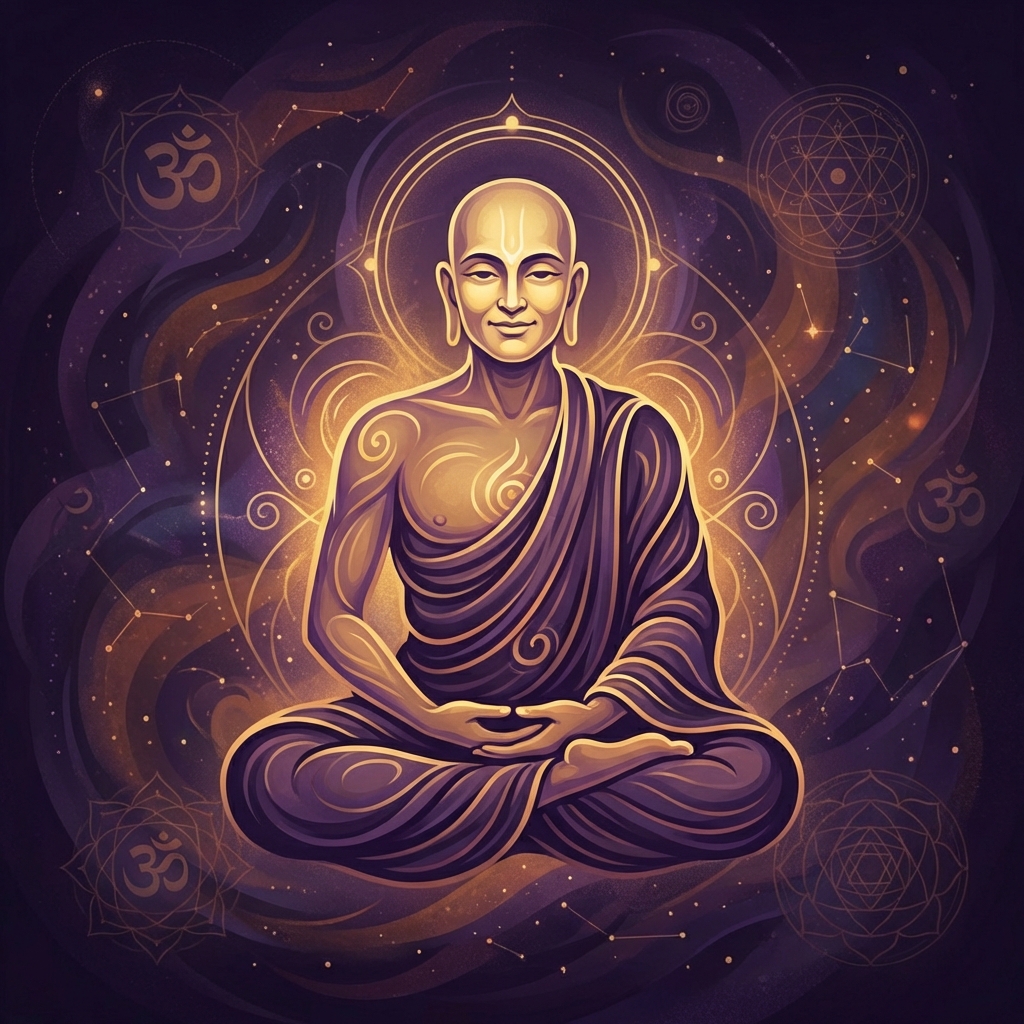
What if I told you that the most enlightened being in ancient India looked like a walking question mark?
What if the greatest spiritual teaching ever recorded—one that makes the Bhagavad Gita look like kindergarten homework—came from a twelve-year-old boy with a body so twisted that the entire royal court burst into laughter when they saw him?
And what if that same boy, in a single conversation, enlightened a king—while the most learned scholars of the land sat in stunned silence?
This is the story of Ashtavakra.
And it might just shatter everything you believe about what it takes to be free.
Part 1: The Curse Before Birth
The story begins in a hermitage, with a father named Kahola—a learned Vedic scholar, dedicated to the sacred texts. His wife, Sujata, was pregnant with their first child.
Kahola had a habit: he would recite the Vedas aloud, practicing proper pronunciation and intonation. The correct chanting of Vedic hymns was considered sacred—each syllable had to be perfect.
One night, as Kahola recited, something happened that shouldn't be possible.
Something that would change everything.
A voice came from his wife's womb.
"Father," the unborn child spoke, "you have made eight errors in your recitation."
Imagine this: a baby, still in the womb, correcting a scholar. Not once, not twice—but identifying eight specific mistakes.
Kahola was not enlightened enough to appreciate this miracle. Instead, his ego was wounded. A learned Brahmin, corrected by his unborn son? His pride couldn't bear it.
In a moment of rage, Kahola cursed his own child:
"Since you have found eight faults in my recitation, may you be born with eight deformities in your body!"
— Kahola's curse
And so it happened. The child was born with his body bent in eight places—head, hands, feet, knees, chest. He was named Ashtavakra—literally meaning "one with eight bends."
The First Lesson
Right here, at the very beginning, the story teaches us something profound:
Truth spoken from innocence will always threaten the ego.
The child was right. The father was wrong. But because the father identified with his scholarly pride, he couldn't receive the gift. Instead, he punished the one who offered it.
How many times do we do this? Someone speaks truth to us, and instead of listening, we attack the messenger.
But wait—the story gets darker before it gets light.
Part 2: The Father's Defeat
Shortly after this incident, Kahola traveled to the court of King Janaka—the philosopher-king of Mithila. Janaka was famous for hosting philosophical debates, where scholars from across India would compete for honor and recognition.
At this time, a scholar named Vandin was dominating these debates. He had a fearsome record: anyone who lost to him in argument would be drowned in the river. It was debate to the death.
Kahola, confident in his learning, challenged Vandin. But Vandin was no ordinary debater—he was sharp, quick, ruthless. Kahola lost.
And Kahola was drowned.
Sujata, now a widow, raised young Ashtavakra alone. She didn't tell him about his father's fate. Instead, her father (Ashtavakra's grandfather, the sage Uddalaka) stepped in to raise the boy.
For years, Ashtavakra grew up believing Uddalaka was his father. He didn't know he was an orphan. He didn't know his real father had cursed him and then died in defeat.
Until the day the truth found him...
Part 3: The Truth Revealed
At the age of twelve, Ashtavakra was sitting on Uddalaka's lap—as he often did, believing him to be his father.
Another child, jealous or simply cruel, mocked him: "Why do you sit on this man's lap? He is not your father. Your real father was drowned by Vandin in King Janaka's court."
The revelation shattered Ashtavakra's world. His body might have been crooked, but his spirit was made of fire. At just twelve years old, he made a decision:
"I will go to Janaka's court. I will defeat Vandin. I will free my father's soul."
His mother and grandfather tried to stop him. A twelve-year-old boy, twisted in body, going to challenge the most fearsome debater in the land? It was suicide.
But Ashtavakra was unmoved. He set out for Mithila.
A twisted boy. A deadly debater. A king's court.
What happened next would echo through 2,500 years of history.
Part 4: Entering Janaka's Court
When Ashtavakra arrived at the court, the guards tried to stop him. A deformed child wanted to participate in the royal philosophical debate? Unthinkable.
But Ashtavakra pushed his way through. He limped into the magnificent hall where hundreds of learned scholars sat—men who had spent their entire lives studying the scriptures.
And when they saw him—this twisted, hobbling boy—they burst into laughter.
The entire court laughed. Scholars, ministers, nobles—everyone found this deformed child hilarious.
But Ashtavakra didn't shrink. Instead, he looked around the court, and then he did something that silenced everyone:
He laughed louder than all of them.
King Janaka was intrigued. He asked, "Child, why do you laugh?"
Ashtavakra replied with words that would echo through the ages:
"I came to this court thinking I would find learned men, seekers of truth. But I find only leather merchants—people who can only see skin, not the soul within.
You look at my crooked body and laugh. But you cannot see that the one who dwells within this body is untouched by its shape.
I laugh at your blindness. You have spent your lives studying scriptures, yet you cannot see beyond the surface."
— Ashtavakra to Janaka's court
The laughter died. Shame filled the hall.
In that moment, King Janaka recognized that this was no ordinary child. This boy saw something they couldn't see.
The scholars who studied for decades were blind. The twisted child who could barely walk—he could see.
Part 5: The Defeat of Vandin
Janaka allowed the debate. Twelve-year-old Ashtavakra stood before Vandin—the man who had defeated and drowned his father.
What followed was an intellectual battle of the highest order. Vandin threw complex philosophical questions at Ashtavakra. But the boy was ready. His understanding came not from books, but from direct realization.
Point by point, verse by verse, Ashtavakra dismantled Vandin's arguments. The entire court watched in astonishment as a twelve-year-old boy defeated the undefeated champion.
When Vandin was finally defeated, Ashtavakra demanded justice:
"Let Vandin be drowned, as he drowned my father and all the others."
But here, the story takes an unexpected turn.
Vandin revealed a secret: He was the son of Varuna, the god of waters. All the scholars he had "drowned" were not dead—they were alive, participating in a sacred ritual in Varuna's underwater realm. Now that the ritual was complete, they could return.
Kahola emerged from the waters—alive.
Father and son were reunited. And when Kahola saw what his son had become—saw the wisdom that had matured despite the curse—he blessed him. The curse was lifted.
(In some versions, Ashtavakra's body straightened; in others, he remained bent, seeing no importance in the body's shape. Both are true teachings.)
But here's the twist nobody talks about:
Ashtavakra could have gone home. Mission accomplished. Father saved. Story over.
Instead, he stayed. And what happened next created one of the most revolutionary texts in human history.
Part 6: The Dialogue That Changed Everything
But Ashtavakra's greatest work was yet to come.
King Janaka, despite being a powerful ruler, was a true seeker. He had everything the world could offer—wealth, power, pleasure—yet he knew there was something more.
He approached Ashtavakra with the most fundamental questions a human can ask:
"How can I attain liberation?"
"How can I know the Self?"
"How can I become free?"
The answer Ashtavakra gave became the Ashtavakra Gita—298 verses of the most radical spiritual teaching ever recorded.
Unlike other scriptures that prescribe practices, rituals, meditations, and gradual paths, Ashtavakra's teaching was shockingly direct:
"You are already free. You have always been free. You will always be free.
You are not the body. You are not the mind. You are not the doer. You are not the experiencer.
You are pure awareness—unchanging, infinite, complete.
There is nothing to attain, nothing to become, nothing to do.
Just see what you already are."
— Essence of Ashtavakra's teaching
Part 7: The Core Teachings of Ashtavakra Gita
1. You Are Not the Body
Ashtavakra's own life was the first teaching. His twisted body was irrelevant to his consciousness. He demonstrated that the Self is the witness of the body, not contained by it.
"If you identify with the body, bondage and death await you. If you know yourself as awareness itself, you are instantly free."
— Ashtavakra Gita 1.4
2. You Are Not the Mind
Thoughts come and go. Emotions rise and fall. But you—the one who observes all this—remain unchanged. The mind is like clouds passing through an infinite sky. The sky is never touched by the clouds.
"You are not the doer. You are not the enjoyer. You have always been free."
— Ashtavakra Gita 15.8
3. The World is an Illusion (Maya)
Not that the world doesn't exist—but that it doesn't exist the way you think it does. What you see as solid, separate, permanent—is actually fluid, interconnected, and temporary.
"The world is nothing but a mirage. When you see this clearly, desire and aversion vanish on their own."
— Ashtavakra Gita 2.19
4. There Is No Duality
The separation between "you" and "God," between "self" and "world," between "subject" and "object"—is an illusion created by the mind. In truth, there is only One.
"You are the one witness of all things, and are always totally free. Your only bondage is not seeing this."
— Ashtavakra Gita 1.7
5. Nothing Needs to Be Done
This is perhaps the most radical teaching. Most spiritual paths say: "Do this practice for 20 years and you will become enlightened." Ashtavakra says: You are already enlightened. Just stop doing things to become what you already are.
"There is no need for meditation, no need for scripture, no need for practice. Just know yourself as pure consciousness—and you are free."
— Ashtavakra Gita 1.15
6. Witness Everything
Instead of trying to control, change, or improve yourself—simply watch. Be the witness. Happiness comes, watch it. Sadness comes, watch it. Thoughts come, watch them. In this witnessing, you discover that you are the unchanging space in which everything appears and disappears.
"Let go of everything. Remain as pure awareness. Just witness happiness and suffering as they come and go. You are not affected by them."
— Ashtavakra Gita 5.1
Part 8: The Moment of Janaka's Enlightenment
There's a famous story, though not in the original text, that captures the essence of Ashtavakra's teaching:
King Janaka was riding his horse when he encountered Ashtavakra. Out of respect, he began to dismount—one foot in the stirrup, one foot in the air.
Ashtavakra immediately commanded: "STOP! Stay exactly as you are!"
Janaka froze, balanced between horse and ground.
In that moment of suspension—not doing anything, not going anywhere, just present—Janaka was enlightened.
The teaching? Liberation is not at the end of a journey. It is in the stillness of this very moment.
Part 9: Why Ashtavakra's Teaching Is So Radical
Compare Ashtavakra's approach to other teachings:
The Bhagavad Gita says: Do your duty, perform action without attachment, and
gradually purify yourself.
Patanjali's Yoga Sutras says: Practice eight limbs of yoga, control the mind
through years of discipline.
Buddhism says: Follow the eightfold path, practice meditation, and over many
lifetimes, reach nirvana.
Ashtavakra says: You're already there. You've always been there. Stop trying to get somewhere.
This is why the Ashtavakra Gita is considered the most advanced Advaita (non-dual) text. It's not for beginners. It assumes you're ready to hear the final truth without any preparation.
Still with me? Good. Because now we get to the part that matters most: Why should you care about a 2,500-year-old conversation?
Part 10: The Practical Relevance Today
How does a 2,500-year-old text matter in 2026?
For the Anxious Mind
We live in an age of constant doing—productivity, achievement, self-improvement. Ashtavakra says: You are not your achievements. You are not your failures. You are the awareness in which both appear.
For the Seeker
Many people spend years seeking "enlightenment" through workshops, retreats, and practices. Ashtavakra asks: Who is seeking? Can you find this seeker? And when you look for the seeker, what do you find? Just awareness looking at itself.
For the Suffering
In times of pain—physical, emotional, psychological—Ashtavakra's teaching is a liberation: You are not the pain. You are the witness of the pain. The pain appears in you; you do not appear in the pain.
For Everyone
The teaching applies universally: You are not what you think you are. You are something infinitely simpler, infinitely more free, infinitely more peaceful.
Part 11: Key Verses to Contemplate
"You are pure awareness. The world is an illusion. Nothing more. When you understand this, desire and aversion disappear."
— Ashtavakra Gita 1.9
"If you detach yourself from identification with the body and rest in intelligence, you will quickly become happy, peaceful, and free from bondage."
— Ashtavakra Gita 1.4
"The Self is witness, all-pervading, perfect, free, one, awareness, action-less, unattached, desireless, at peace. The world appears through illusion to be different."
— Ashtavakra Gita 1.12
"You have no caste, no duties. You are invisible, unattached, formless. You are the witness of all things. Be happy."
— Ashtavakra Gita 1.5
Conclusion: The Gift of Ashtavakra
Ashtavakra's story is not just history. It's a living teaching.
A child cursed before birth, born into a twisted body, mocked by the world—yet he saw through the illusion completely. His "defects" became his greatest teaching. His body proved the teaching true: You are not the body.
And his message to King Janaka—and to all of us—remains the same:
You are already free.
You have always been free.
You can never be anything but free.
The only bondage is not knowing this. The only liberation is recognizing what you already are.
Stop seeking. Start seeing.
"The fool seeks happiness in the distance. The wise grows it under his feet."
— Ashtavakra's essence
🙏
— Rajnish Bodha